.svg)



.svg)

.png)
2025 was one of the most turbulent years in recent memory for logistics and e-commerce.
Tariffs reshaped sourcing and shipping strategies — and even consumer demand. Customer expectations continued to climb. More shipping and logistics options became available than ever before. And AI moved from hype to reality. In 2026, these forces won’t slow down — they’ll converge and accelerate.
Below are my ten predictions for the year ahead — the trends I believe will meaningfully shape how brands not only ship, but how they think about shipping, how consumers experience delivery, and how the industry evolves.
1. AI will transform the shipping industry as we know it.
In 2026, I predict AI will become the operational backbone of U.S. logistics.
It won’t happen overnight — but it will happen much faster than most expect.
The logistics industry has traditionally been slow to adopt new technologies. But as U.S. e-commerce continues to grow and parcel volumes are projected to increase roughly 20–25% over the next five years, static pricing models and highly manual processes will no longer scale.
Today, AI already powers routing, pricing, fraud prevention, customer support automation, and delivery-instruction compliance. In 2026, its role will expand across forecasting, real-time network balancing, and dynamic rate cards. It will optimize for speed, reliability, and cost — at the parcel level.
There is no exaggeration here. AI is the biggest technological revolution since the invention of the internet. The companies that understand it — and apply it across their businesses — will unlock massive gains in cost and performance. Those that don’t will fall sharply behind.
2. The ‘Great Diversification from Purple and Brown’ will accelerate.
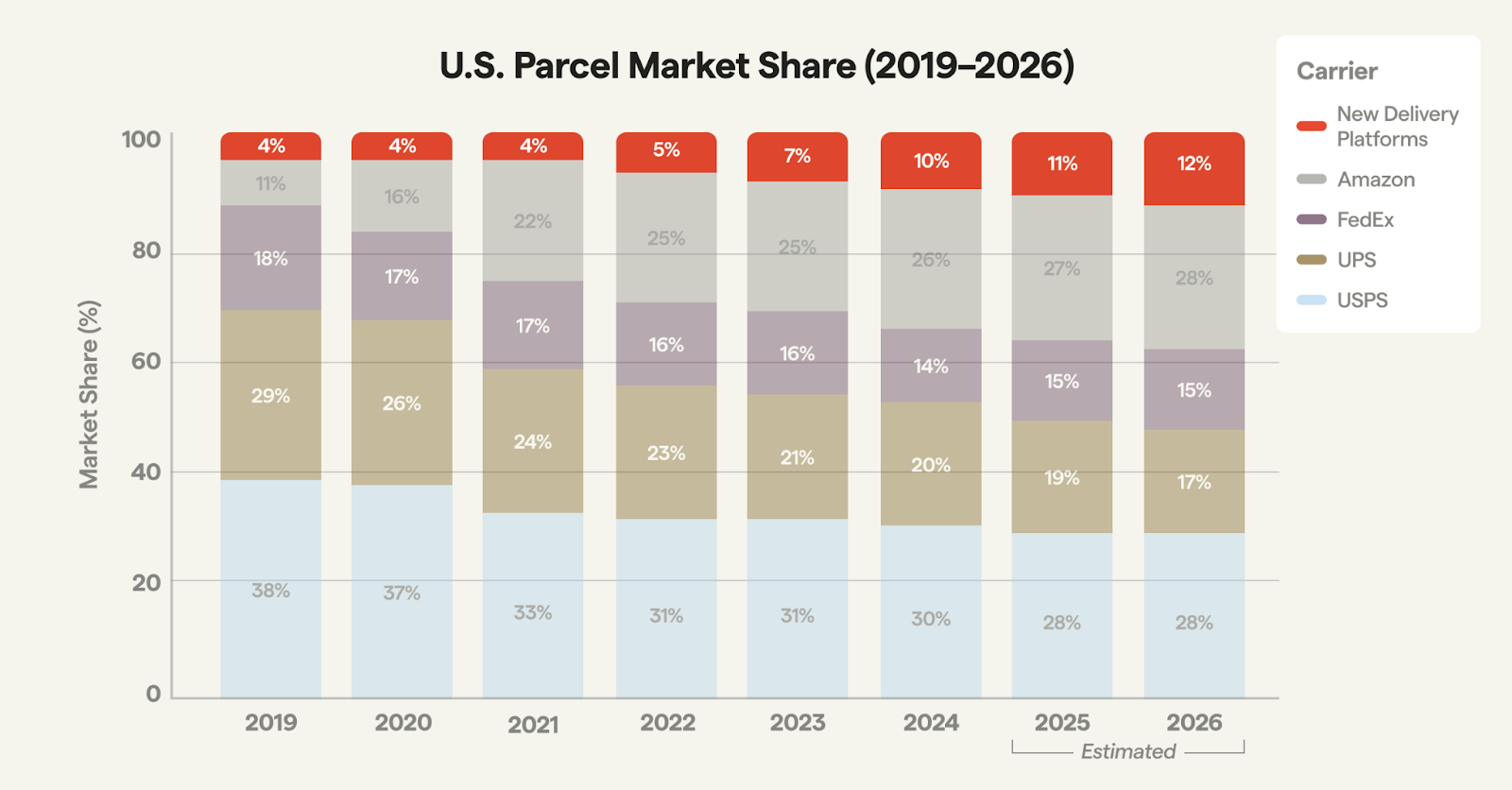
In 2026, I predict more shippers than ever before will shift volume away from UPS and FedEx toward newer shipping platforms whose pricing and service models better align with their needs.
The misalignment between Purple and Brown and the realities of e-commerce has never been sharper. For years, the legacy national carriers have pushed through annual GRIs and an expanding (and often absurd) set of fees, surcharges, and assessorials — while consumers continued to expect brands to offer free (and fast) shipping.
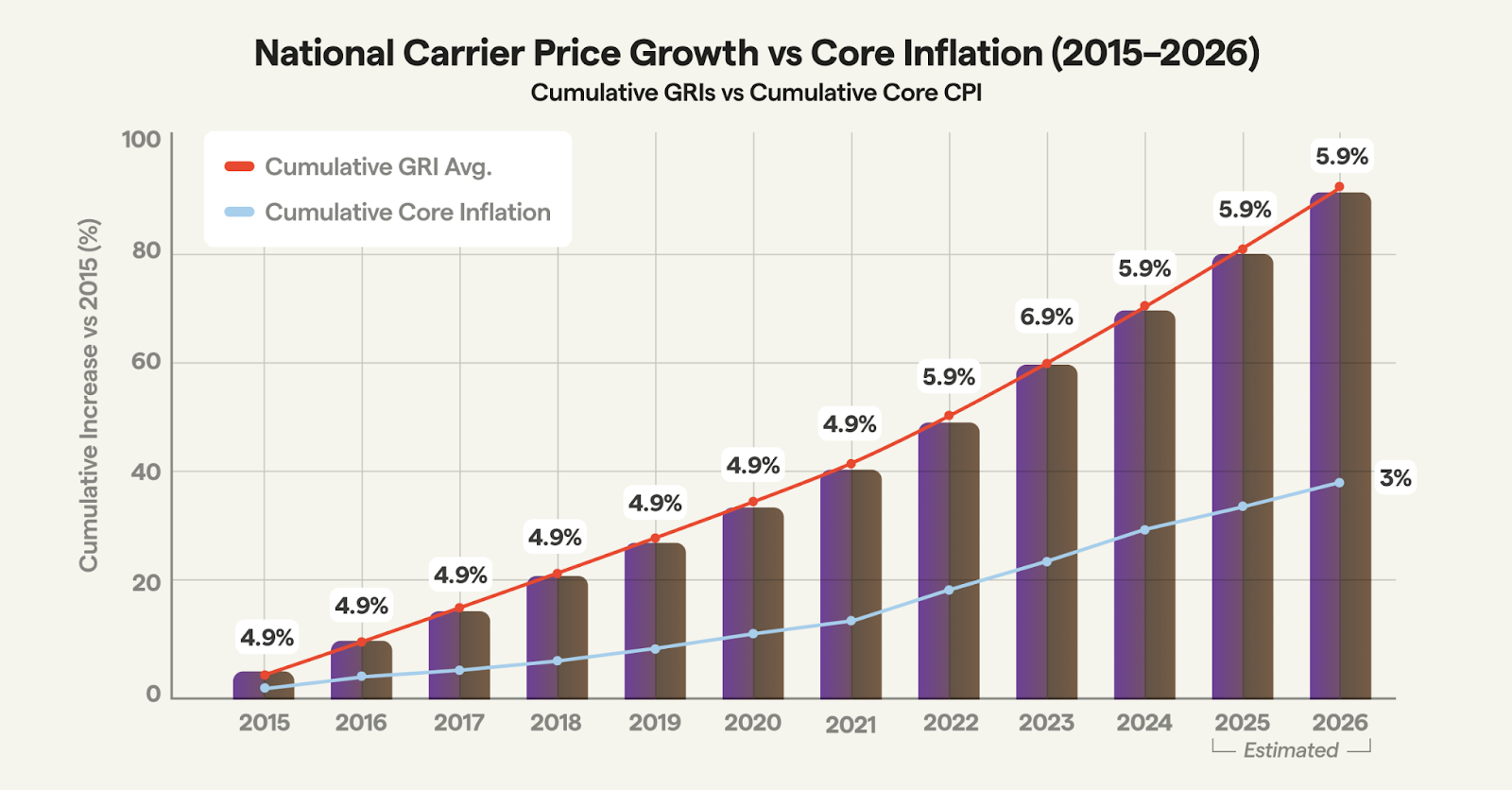
Some brands have already begun diversifying under multi-carrier strategies. Others remain – for now – locked into legacy contracts that penalize them for shifting volume. As those contracts expire, the migration away from legacy carriers will accelerate. And as modern shipping platforms continue to scale, more and more brands will stop shipping with legacy carriers altogether.
By the end of 2026, one in eight parcels will be delivered by new shipping platforms — nearly 3X from only five years ago.
3. Scale will matter far less if you can’t flex.
In 2026, technology-first shipping providers will further widen the gap between themselves and asset-heavy legacy networks.
In a market defined by price compression, CAPEX heavy incumbents have tried to stay competitive by consolidating hubs and restructuring workforces. But those efforts don’t address the core problem: a lack of flexibility.
Flexible, tech-first delivery models — built on partnerships and tech integration across warehousing, middle-mile, and last-mile networks — will adapt faster to changes in demand, cost, and geography.
In 2026, the ability to reconfigure quickly will matter far more than the size of a company’s owned infrastructure.
4. TRUST will become the defining differentiator across the industry.
Years of inconsistent service, surprise surcharges, and transactional relationships have pushed shippers to look beyond Purple and Brown. But even when the economics favor switching, many logistics teams hesitate — and for good reason.
Choosing the wrong carrier can damage customer trust, brand reputation, and careers.
At the same time, the rapid growth of alternative providers — particularly those focused solely on cost — has often come at the expense of reliability. And when consumers lose trust, it’s game over.
In 2026, shippers will screen for trust just as much as price. Transparency, peer validation, real-time performance data, and executive-level engagement will become core criteria in carrier selection.
5. Cost will remain king — but Shipping ROI will finally take center stage.
In 2026, carrier selection decisions will shift from “cheapest rate” to “best ROI.”
The true cost of delivery extends far beyond the label price. Failed deliveries trigger support tickets, refunds, reships, appeasement credits, lost inventory, and churn. These hidden costs compound quickly — and most shipping budgets still ignore them.
As tariffs add pressure and margins tighten, reliable delivery will emerge as one of the most powerful cost-reduction levers available. Shipping will evolve from a cost center into a strategic ROI lever — and brands will start measuring their true “return on shipping.”
6. Tariffs will keep pulling inventory back to the U.S.
In 2026, tariff volatility — and the effective end of the de minimis rule — will continue reshaping inventory strategy.
Cross-border fulfillment will remain part of the mix, but brands will seek greater predictability by pulling volume into U.S.-based warehouses, regional DCs, and micro-fulfillment sites to reduce risk and ensure fast transit time and high on-time delivery.
This shift will tighten delivery expectations — faster promises, narrower windows, and less tolerance for failure — placing new pressure on shipping networks. Some will struggle, but others will continue rising to the occasion.
7. 3PLs will evolve from fulfillment vendors to tech infrastructure.
In 2026, I predict the role of 3PLs will fundamentally change.
Tariffs, margin pressure, and faster delivery expectations are pushing inventory closer to customers — and across more locations. As a result, brands can no longer rely on a single warehouse or a single carrier to compete on cost and speed.
The 3PLs that win won’t be defined by square footage. They’ll be defined by how well they orchestrate inventory, transportation, and delivery across a distributed network.
In this world, flexibility beats scale. And the most valuable 3PLs will look less like warehouses operators — and more like tech infrastructure.
8. Shipper-carrier relationships will evolve from transactional to strategic partnerships.
In 2026, more brands will lean on data rich shipping platforms for strategic value and insight.
The past ten years have mostly been about transactional relationships - particularly between shippers and the legacy carriers. But in 2026, opaque shipping contracts, confusing pricing, misaligned incentives and underwhelming performance will begin to disappear. A new era of transparency and shared accountability will emerge, and the entire e-commerce ecosystem will benefit.
LLMs (large language models) will equip shippers with real time answers about expected delivery times, network stability, weather events and customer feedback; AI will allow brands to aggregate and analyze data and draw unique insights on how to optimize their distribution, volume allocation and shipping contracts.
As data becomes more easily available and reliable, conversations between shippers and carriers will take a more strategic form. Shipping contracts, in turn, will be re-designed to fully align delivery performance and cost with the brand’s business objectives. These changes will hold an immense promise to the industry, reshape relationships, and over time will prove transformational.
In this new world, data rich shipping platforms that are designed to meet each shipper’s unique needs will become more valuable than ever.
9. Robotic delivery will expand — quietly, selectively, and unevenly.

In 2026, robotics still won’t be everywhere. But delivery robots will become increasingly real.
At least in the short term, robots won’t take jobs. Instead, they'll create capacity: automation will increasingly handle consistent volume and repetitive tasks. Humans will begin shifting their focus to judgment calls, exception handling, and customer experience.
More experiments will run with an array of delivery robots – including self-driving vehicles, humanoid robots, and autonomous four-wheelers that can deliver a package all the way to your doorstep.
Most experiments will fail. But a few prove to be incredibly valuable, and the future will look more real than ever before.
10. A smarter checkout page will become the next frontier of shipping innovation.
In 2026, shipping innovation will not only move downstream to our doorstep, but also upstream — straight to the checkout page.
Checkout will no longer be a ‘one size fits all’ where the shopping experience ends. Instead, it will evolve as a dynamic, powerful asset for personalized offerings and a place where tomorrow’s purchase begins. This in turn will increase conversion, margin, and loyalty.
Static shipping options will give way to dynamic, personalized choices. Faster and day-certain - for a fee. Slower and range-certain - for free (or credit for the next purchase). Delivery will become a real-time lever to tailor the perfect offering by product, geography and customer profile.
Conclusion
Many of the forces reshaping shipping and e-commerce are already in motion — AI adoption, carrier diversification, inventory repositioning, and rising delivery expectations. 2026 won’t introduce them; it will expose and shape them, and they will begin to compound.
And compounding leaves little room for indecision.
Some brands will continue to treat shipping as a cost center to minimize. But many others will increasingly view it as a design tool to optimize outcomes for e-commerce and marketing goals, margin and ROI targets, and customer expectations. The gap between these two contrasting philosophies two will widen quickly.
In 2026, those who fully embrace the changing world and utilize it to their advantage — will emerge as winners. The rest will discover that catching up is far harder than it looks — and for some, no longer possible.
Happy New Year!