.svg)



.svg)

Autonomous logistics have arrived. The question is: will you be a first mover or slow to adopt?
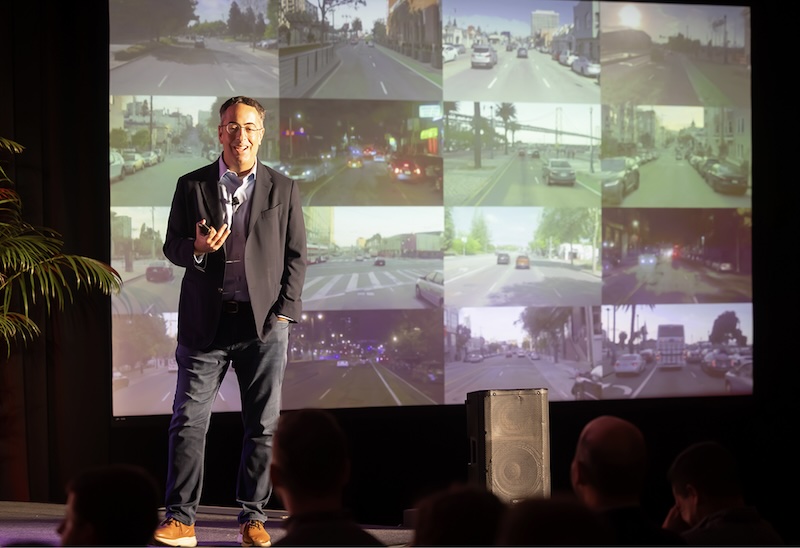
Lior Ron, Chief Operating Officer at Waabi, recently joined us at Veho’s Delivery Summit to break down what’s changed. From advances in AI and simulation to the hardware finally catching up, he shared how the industry has overcome long-standing barriers to autonomy — and what it means for supply chain leaders.
More importantly, he outlined what these shifts unlock: new levels of efficiency, utilization, and speed. Plus, how brands should start preparing their operations now. Here’s what he shared.
The Evolution of AI in Logistics
AI is reshaping how industries operate, and logistics is no exception. As Lior explains, the scale and speed of recent advancements make this shift inevitable. “AI is truly revolutionizing everything around us,” he says. “We now have machines that are more powerful than the human brain, fueled by endless data and computational power. And at the end of the day, logistics is a data and optimization problem. So it’s safe to say AI will fully transform logistics.”
That transformation isn’t happening all at once. Instead, it’s unfolding in three distinct phases, each unlocking new levels of efficiency, automation, and scale.
Phase 1: Digitizing and Automating the Supply Chain
The first phase of AI in logistics has already played out over the past decade. It’s defined by digitization — connecting fragmented systems, reducing manual work, and introducing early forms of automation.
“The last decade was really about digitizing and automating,” Lior explains. “Taking processes, applying basic machine learning, and using that to reduce cost and drive better outcomes. Connecting all the pieces from a digital perspective and enabling automation.”
This shift moved logistics from a largely analog, manual industry to one that is increasingly data-driven. Workflows became more streamlined, decisions more informed, and operations more efficient.
The result was meaningful progress: lower costs, faster execution, and greater visibility across the supply chain. But while digitization improved how logistics systems operate, it didn’t fundamentally change how goods move.
That comes next.
Phase 2: The Rise of AI Agents in Operations
The second phase is unfolding now, driven by the rapid advancement of large language models and agentic AI. These systems go beyond basic automation, enabling companies to streamline complex workflows and support real-time decision-making across operations.
“The last two years have been about the rise of LLMs and agents,” Lior explains. “The models are much more sophisticated, and we can now deploy them across the enterprise.”
At Uber Freight, for example, that shift translated into tangible impact. “In the 12 months before I left, we built around 85 internal agents and deployed them across SOPs and operators throughout the company,” he says. “We were able to reduce operating expenses by about 30%.”
These agents are improving both efficiency and service quality. They can handle repetitive tasks, accelerate response times, and support better customer interactions — all while reducing operational overhead.
For supply chain teams, the opportunity is immediate. “It’s a huge opportunity in terms of efficiency, but also in driving better outcomes,” Lior adds.
But while agentic AI is transforming how logistics teams operate, it still sits on top of existing systems. The next phase moves deeper into the physical movement of goods itself.
Phase 3: Physical AI and the Move to Autonomy
The third phase moves beyond software and into the physical world. Instead of optimizing workflows around logistics, AI begins to automate the movement of goods itself.
“For me, the more exciting part is not just touching the digital fabric on top,” Lior says. “It’s going into the assets and the supply chain and fully automating that with physical AI.”
This is where the biggest transformation happens in the supply chain. While digitization and AI agents improve how teams operate, physical AI changes how the entire system functions. Trucks, warehouses, and other assets become intelligent, autonomous components of the supply chain.
That shift is already underway. “Robots are all around us now, across industries,” he explains. “And the pace of progress has been mind-boggling.”
Recent advances in hardware, AI models, and real-world deployment have pushed autonomy from concept to reality. For logistics, that means moving from assisting human operators to increasingly replacing manual processes altogether.
The Challenge With Scaling Autonomous Logistics
Autonomous logistics has been a compelling idea for a long time. But, until recently, it hasn’t scaled.
Early approaches relied heavily on rules-based systems. “If you look at the early versions, they were extremely hand-engineered,” Lior explains. “You fix something here, and nine other things break.” These systems required massive engineering effort and didn’t generalize well beyond narrow use cases.
The next wave introduced AI, but created new challenges. “Those systems are black boxes,” he says. “You don’t have transparency, you can’t verify safety easily, and you need enormous amounts of data to train them.” In practice, that meant shifting cost from engineers to infrastructure, requiring billions in computing power and data that didn’t exist.
The result was the same: systems that were too brittle, too expensive, and too limited to scale across real-world logistics networks.
Why Autonomous Logistics Is Finally Possible
Today, three forces are converging to make autonomy viable at scale: hardware readiness, advances in AI, and growing market demand.
First, the hardware has caught up. “One of the longest poles for self-driving adoption was the hardware — the trucks, the OEM readiness,” Lior explains. That barrier is now largely gone. Major manufacturers are producing autonomous-ready vehicles with fully redundant systems, and the broader ecosystem — from Tier 1 suppliers to production infrastructure — is finally in place. “For the first time ever, we have a self-driving hardware ecosystem that is getting to be very mature.”
Second, AI has reached a level of sophistication that makes real-world deployment possible. “The technology is finally upon us,” he says. “There’s been a huge pull in terms of what AI can now do.” At Wabi, that means building systems that can generalize across environments while remaining efficient and verifiable. “We want a system that can deploy at a wide scale — not something limited to a very specific use case.”
A key enabler is simulation. “We’ve built a simulator that mirrors the real world almost perfectly,” Lior explains. “If a truck runs 100,000 scenarios in the real world and in simulation, 99.7% of the time it ends up in the same place.” That level of accuracy allows teams to train and validate systems at a scale that wasn’t previously possible, simulating millions of edge cases and ensuring systems respond safely. What once took years and thousands of engineers can now be achieved in months, with a fraction of the cost.
Finally, demand is accelerating. Shippers are actively looking for solutions that improve capacity, safety, and efficiency.
Together, these forces are driving a new wave of investment and progress. What was once theoretical is now practical — and the industry is moving quickly toward real-world deployment.
From Hub-to-Hub to Door-to-Door Autonomy
Even with these advances, the biggest unlock isn’t just autonomy — it’s where that autonomy can operate.
Historically, the industry has been limited to hub-to-hub deployments — autonomous trucks moving between terminals on highways. But that model has fundamental limitations.
“Hub-to-hub doesn’t scale,” Lior says. It introduces added cost, complexity, and operational friction, requiring human drivers and infrastructure at both ends of the journey.
The real opportunity is extending autonomy beyond the highway.
“The value is meeting the customer where they are,” he explains. That means moving from controlled environments into surface streets, distribution centers, and delivery locations — handling the full journey from origin to destination.
Waabi has already begun demonstrating this capability. “For the first time, we’re not limited to hub-to-hub,” Lior says. “We can go from door to door through surface streets, into facilities, and complete the delivery end to end.”
That shift is critical for both economics and scalability. Without it, the cost savings of autonomy are offset by the added complexity of splitting routes and introducing manual handoffs.
With it, autonomous logistics can integrate seamlessly into existing supply chains and unlock meaningful efficiency at scale.
What Comes Next: Scaling Autonomy Across the Network
Autonomy is entering real-world deployment. The next phase is about scaling: expanding from controlled pilots to widespread adoption across major freight corridors, fleets, and eventually the full logistics network.
From Pilot to Production
“We now have a system that is fully performant and ready to be deployed,” Lior explains. Autonomous trucks are already operating in complex environments, including surface streets, and are nearing full driverless deployment in Texas.
Production is catching up quickly. “Volvo is ready with a fully production-ready, redundant truck,” he says. “We’re talking about driverless deployment starting in Texas as early as the end of this year.”
Early Adoption Is Already Underway
Adoption is happening faster than many expect. “We’re actively working with dozens of Fortune 500 companies,” Lior says, with pilots already running on major lanes like Dallas to Houston.
Even in early testing, the performance is strong. “We’ve seen 100% on-time pickup and delivery, and 99.6% autonomy,” he notes. These results are driving increased interest from shippers looking to improve reliability and efficiency.
A Step Change in Utilization and Cost
The biggest impact comes from how autonomous trucks are used. “With driverless systems, you’re no longer constrained by hours of service,” Lior explains. Trucks can operate 24/7, increasing utilization by 2 – 3x and enabling entirely new operating models.
That unlocks new possibilities:
- Continuous relay routes between distribution centers
- Faster transit times across long distances
- The ability to collapse multi-day routes into single-day moves
At the same time, cost structures begin to shift. Driver-related expenses, fuel inefficiencies, and insurance models are all impacted, creating a meaningful cost advantage for early adopters.
Rapid Scaling Over the Next Five Years
This isn’t a slow rollout. “We’re talking hundreds of trucks next year, thousands shortly after, and tens of thousands within five years,” Lior says.
Even at smaller volumes, the impact is immediate. As autonomous capacity enters key lanes, it will begin influencing pricing, procurement strategies, and carrier selection.
“Once a carrier can bid meaningfully below competitors because they’ve adopted autonomy, the market will move quickly,” he adds.
What This Means for Supply Chain Leaders
Over the next two years, supply will be limited, and early adopters will secure the majority of available capacity. “There’s going to be a choice,” Lior says. “Do you want to be early, or wait and see?”
His advice is simple: start preparing now. “At a minimum, seek to understand what’s happening,” he says. That includes evaluating total cost of ownership, identifying high-potential lanes, and assessing how autonomy could impact network design.
Because within a few years, autonomy will be a competitive advantage embedded in how supply chains operate.
Build For the Autonomous Future of Logistics
Autonomous logistics is moving into real-world deployment, with meaningful implications for how supply chains are designed, operated, and optimized.
As Lior outlines, this shift isn’t just about new technology. It’s about a new operating model. One where trucks run continuously, networks move faster, and efficiency gains compound across the entire system. The brands that benefit most won’t be the ones reacting late — they’ll be the ones preparing early.
That doesn’t mean overhauling your network overnight. But it does mean starting now: understanding where autonomy fits, identifying high-impact lanes, and thinking differently about cost, capacity, and speed.
Because as adoption accelerates, autonomy will be a differentiator.
To hear more from Lior Ron on what’s ahead and how to prepare, download the full session from shipveho.com/deliverysummit